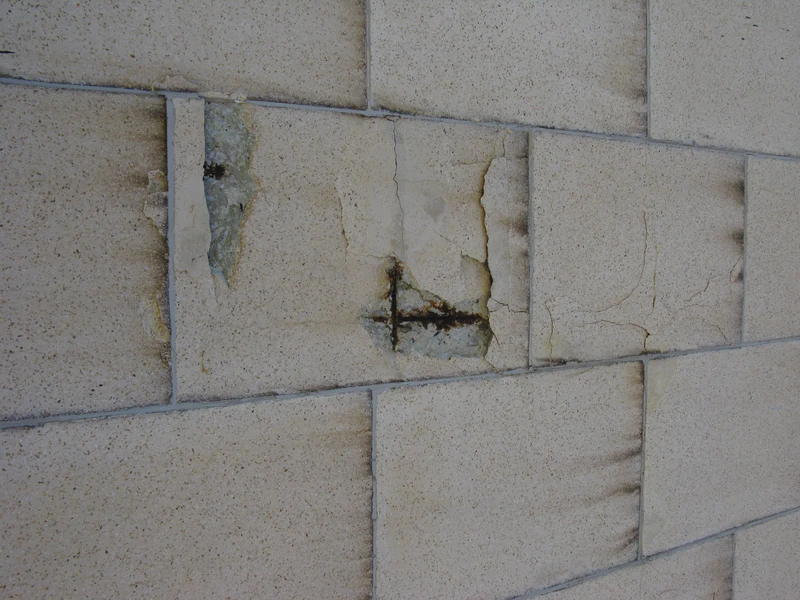
A crack is an observation that needs context. Its appearance alone does not establish the cause, depth, movement, effect on durability or significance to structural safety.
The photographs in this article are real, independently sourced examples, credited individually. They are not Konstraff inspection records or diagnostic standards. No crack dimension or structural conclusion should be inferred from these pictures.
This article offers a practical recording and escalation approach. It does not replace a project-specific assessment by the responsible engineer.
Why concrete can crack
NRMCA’s guidance describes cracking associated with moisture and temperature changes, restraint, loading and support conditions. Avoiding every crack is not a realistic universal expectation, and reinforcement does not eliminate cracking altogether. The important questions include why the crack formed and whether the result meets the member’s intended performance and project requirements. Source: NRMCA, CIP 4: Cracking Concrete Surfaces.
That is not permission to dismiss a crack. Equally, the presence of a visible line is not, on its own, proof of structural failure. Begin with the observation and keep the proposed explanation separate until it has been assessed.
Example 1: a cracked floor in context
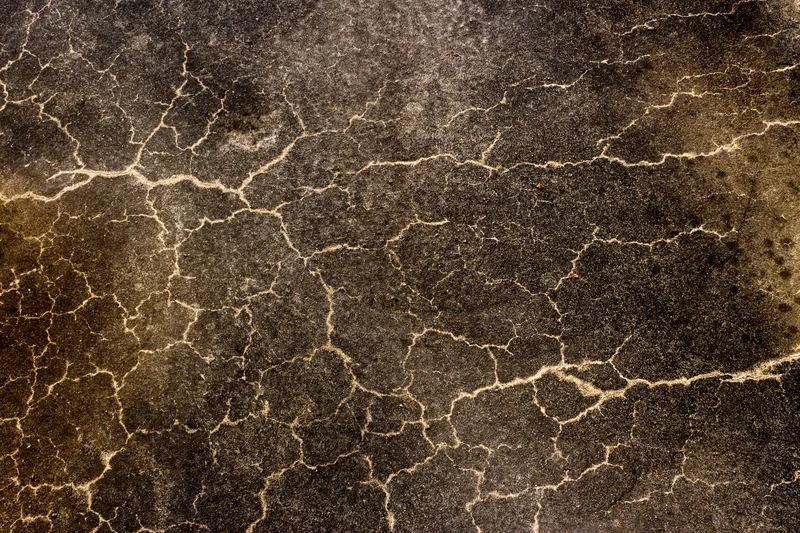
For a similar observation on a real project, our suggested first record would identify the slab location, pour date if known, when the crack was first observed, its route in relation to joints and supports, and whether there is displacement or evidence of change. Establish safe access before any close inspection.
“Shrinkage crack” should not be a default label written simply because a crack appears narrow. NRMCA distinguishes plastic shrinkage, occurring in fresh concrete when surface moisture loss exceeds replenishment, from other cracking mechanisms. Wind, temperature and humidity are relevant to that early-age process, but appearance without the construction history is not enough to assign it. Source: NRMCA, CIP 5: Plastic Shrinkage Cracking.
Example 2: a crack along a concrete element
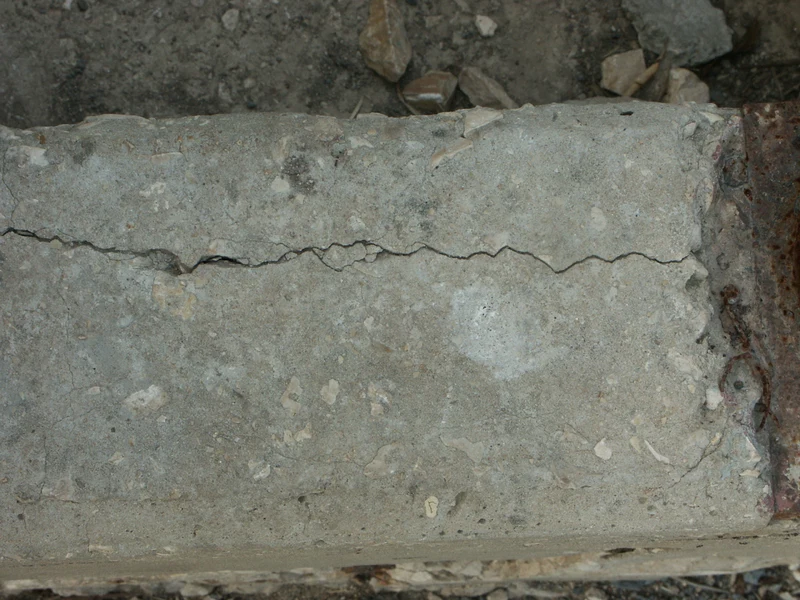
In a real observation, the position of the crack within the element is useful information for the engineer. So are the member’s role, relevant drawings, construction sequence, loading history and any observed movement. Record the pattern accurately rather than assigning a cause from its direction alone.
As a precautionary response, rapidly changing cracking, visible displacement, unexpected sagging or falling concrete should trigger the site’s safety and escalation procedures. Keep people away from the affected area, stop affected work as appropriate and involve the responsible engineering and site-management functions urgently. Do not approach an apparently unstable area merely to obtain a better photograph; use emergency procedures where necessary.
Fine networks are not all the same
NRMCA describes crazing as a fine, shallow network associated with the surface paste. That is a particular condition, not a name for every network of cracks. Its guidance should not be used to classify a real surface as harmless just because it resembles a sample picture. Source: NRMCA, CIP 3: Crazing Concrete Surfaces.
The practical point is to retain uncertainty in the record. “Fine interconnected surface lines observed” is an observation. “Only cosmetic crazing” is a conclusion that needs an appropriate basis.
Create a record the engineer can use
We suggest a consistent crack register with a unique reference and an annotated location plan. Include the observation date, available concrete and construction records, contextual photographs and close views obtained safely. Record any leakage, staining, surface separation or displacement rather than documenting the line in isolation.
Where measurement is appropriate, use a suitable real instrument and a defined method. Record where the reading was taken, the conditions, and the date. Repeat readings at consistent reference locations only under an agreed monitoring arrangement. A series of comparable observations is more informative than unrelated close-up photographs.
Keep original images. Markups should help locate the observation without obscuring it. If the area is repaired later, retain the before-and-after record and the decision that authorised the work.
Avoid a universal pass-or-fail width
This article deliberately gives no single crack-width threshold for acceptance. The appropriate criterion depends on the member, design basis, exposure, intended function and applicable project requirements. Appearance and a width reading are inputs to assessment, not substitutes for it.
Ask the responsible engineer to define what needs to be established: movement, depth, cause, structural implications, durability, watertightness, or another relevant performance question. Any monitoring or testing should answer that question with an agreed method and responsibility.
Decide the response after assessment
We recommend keeping the observation open until there is a documented disposition: further assessment, monitoring, an approved repair, or acceptance against the applicable requirements. Do not cover the evidence first and attempt to explain the cause later.
Where a repair is required, its method and acceptance criteria should follow the assessment and project approvals. Filling a visible line is not, by itself, evidence that its underlying cause or consequences have been resolved.
Link the outcome to the quality-assurance record: location, requirement, decision, implementation and verification. If preparation or execution contributed to the issue, carry the learning into the next work package.
Observe accurately. Preserve the evidence. Escalate appropriately. Let assessment determine the response.